




Your Marketing Team Doesn't Have a Design Problem. It Has an Execution Problem.
The campaign was approved on the 3rd. The brief went to the designer on the 9th. First round came back on the 12th, feedback from four people arrived between the 12th and the 17th, round two landed on the 19th, the CEO saw it on the 22nd and asked for a different headline, and the thing went live on the 26th. Three weeks and change. The design work inside that timeline took about two days.
Marketing execution is the work between an approved plan and a published asset: turning a decision into a brief, a brief into a draft, a draft into something everyone has signed off, and that into something live on the right channel on the right day. When that stretch takes three weeks instead of one, the diagnosis is almost always the same: we need a better designer, or a faster agency. And it is almost always wrong.
The swap-the-designer reflex
When work is late, inconsistent, or half-finished, the problem is easiest to notice when a design lands in your inbox. So naturally, that’s where the blame goes: the freelancer is too slow, the agency doesn’t get us, or the in-house designer is overloaded.
A new vendor comes in, everyone feels optimistic for a while, and then the same campaign still takes three weeks, just with different hands.
We see this from a different angle. When a team starts working with Bespire, our project manager gets to see the whole workflow: how requests come in, who sets priorities, what the brief looks like, how many people give feedback, and who makes the final call.
What we often find is pretty simple: the previous designer wasn’t the problem. The process around them was. And that process often follows the work to the new vendor.
This isn’t only a small-team problem. Adobe’s January 2026 productivity research, based on 1,106 full-time US employees, found that 38% of marketers cited unclear priorities as the biggest cause of lost productivity. Marketers also estimated losing 91 business days a year to administrative work.
That time isn’t spent designing. It’s lost in everything happening around the design.
Where the time actually goes
Take an ordinary asset: a launch email with a hero image and two variants.
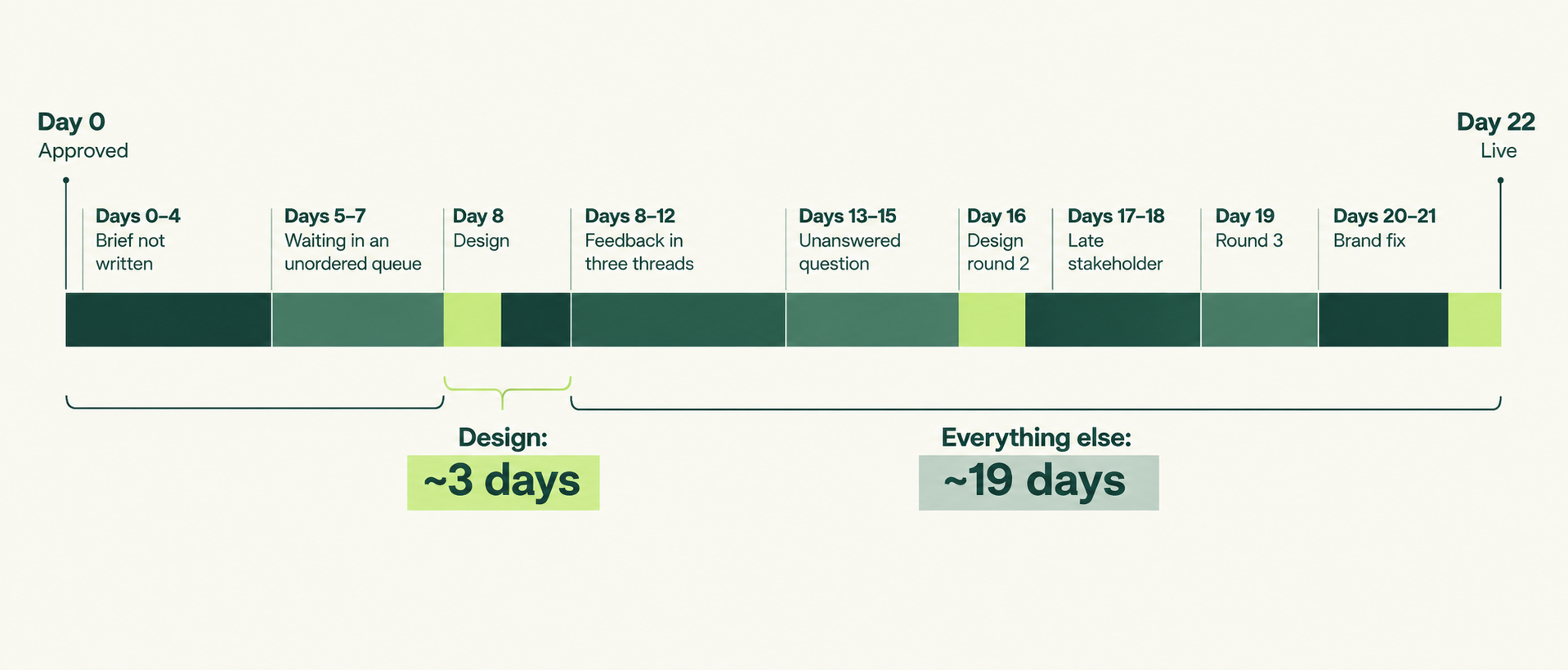
The campaign is approved on Day 0. The brief takes four days to come together. By Day 5, the request reaches the designer behind three other Slack requests, with no clear priority. The first draft is ready by Day 8.
Then the waiting starts. Feedback comes from marketing, sales, and the founder in separate threads. A question sits unanswered for two days. By Day 17, the founder sees the work properly for the first time and wants a different angle. A third round follows. Then someone catches a brand issue from an old template. Day 22: live.
The actual design work took roughly three days. The other nineteen went to briefing, queueing, feedback, approvals, and brand checks. None of that was the designer’s job. And nobody owned it.
Five things that look like design problems and aren't
Once you know where the days go, the symptoms sort themselves. Each of these gets blamed on the designer, and each has a different cause.
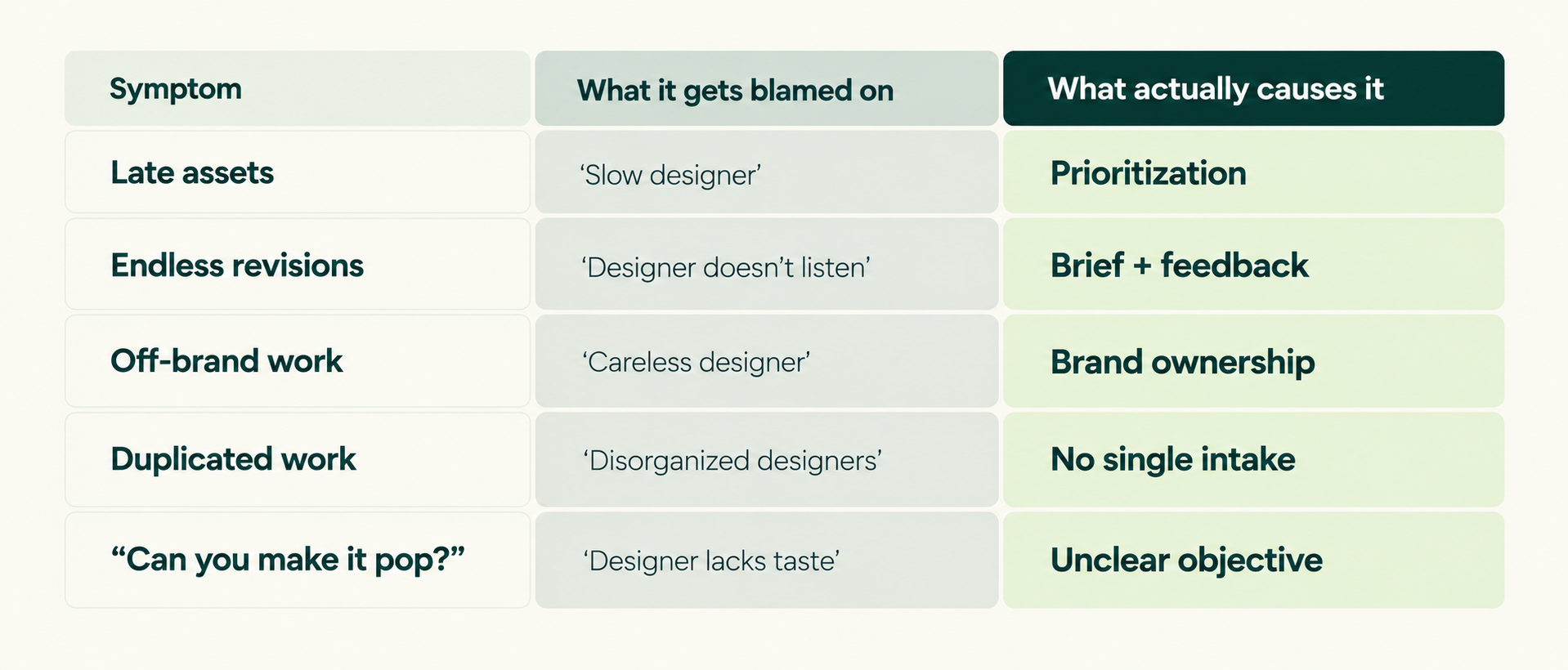
Late assets. A designer who receives requests in no particular order, with no stated deadline and no one deciding what comes first, will always be late on something. The cause is missing prioritization, not missing speed. Adding a faster designer to an unordered queue produces a faster designer working on the wrong thing.
Endless revisions. Three rounds usually means the brief asked for an asset rather than describing a decision. "A launch email for the new feature" is not a brief; "an email whose only job is to get existing customers to book a demo of feature X, approved by Dana, must reuse the launch hero, due Thursday" is. Revision rounds are a brief problem and a feedback-consolidation problem, and they survive every designer change.
Off-brand work. When five people touch a brand, each one decides the edge cases, and there are always edge cases. The template from last quarter, the slightly different blue, the headline style that one freelancer prefers. That is not carelessness; it is the absence of a single brand interpreter with the authority to say how the guidelines apply. Guidelines describe a brand. They do not decide.
Duplicated work. Two people request the same one-pager in different channels; two designers make two versions; nobody notices until both are in a shared drive. Duplicated work only happens when there is no single intake. It is invisible on a per-asset basis and enormous in aggregate.
"Can you make it pop?" The most quoted symptom, and the least understood. Vague feedback is what people give when they were never asked what the asset was for. The cure is upstream, in a brief that states the job and names the approver, so that feedback can be measured against something.
The pattern across all five: the failure is in the layer that receives, orders, describes, reviews and standardizes the work, and that layer usually has no owner.
What an execution layer is
Sales teams learned this a decade ago. Nobody argues any more that a company with eight reps needs someone to own pipeline hygiene, territories and the CRM; that is sales operations, and its absence shows up as missed forecasts rather than lazy reps. Finance has the same idea. Marketing production mostly does not, and the same failure shows up as late campaigns and blamed designers.
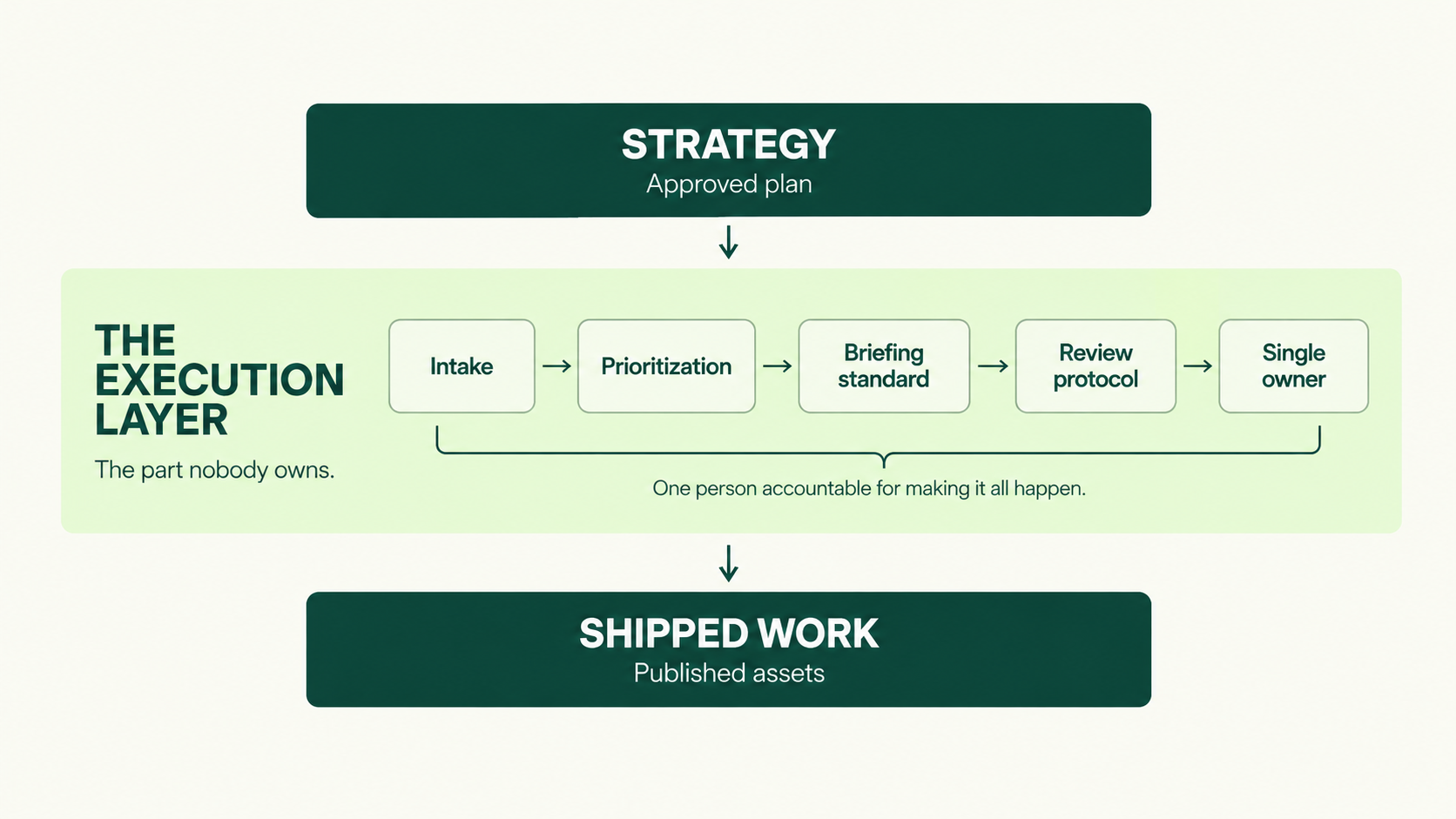
The execution layer is everything that happens between an approved plan and a finished, shipped asset. It comes down to five things:
1. Intake: One place where every request comes in, using the same basic information each time.
2. Prioritization: A clear rule for what gets done first, and someone who makes that call. The queue shouldn’t be ordered by whoever sends the most Slack messages.
3. Briefing standard: A short brief that answers the essentials: What is this for? Who is it for? Who approves it? What should we reuse? When is it needed?
4. Review protocol: Feedback gets consolidated into one round, with one voice and a named approver who can sign it off.
5. A single owner: Someone is accountable for making all four happen and for protecting the people doing the work from everything that isn’t the work itself.
None of this requires software or headcount. It requires someone to own it, and in most lean teams nobody does, because the layer is invisible until it breaks and everyone assumes it is somebody else's job. HBR Analytic Services' March 2026 study of 522 B2B professionals, commissioned by LeanData, found that 83% considered their go-to-market strategy very important while only 38% rated their execution as equally effective. The gap between those two numbers is not a strategy problem. It lives here.
Two teams, same designer count
Two patterns show up often enough to be worth describing as composites. Neither is a specific client. The point is what changed — and what didn’t.
The first team changed its production setup three times in a year: an in-house designer who left, a freelancer who was excellent but unavailable, and an agency that was thorough and slow. Each change brought the same honeymoon period, followed by the same problems: briefs written the night before, feedback from five people in five threads, and a founder seeing the work for the first time at the end. The designer changed. The twenty-two-day timeline didn’t.
The second team kept its designer and changed one thing: it gave the queue an owner. Requests went through one form, the owner ran a fifteen-minute weekly triage, briefs included a “who approves this” field, and feedback was consolidated before reaching the designer.
Nothing else changed, including the designer’s speed. The timeline shortened because the nineteen days that weren’t design got shorter.
In the first month, that review surfaced requests that weren’t actually urgent, as well as work that had entered the queue before the necessary information was ready. Once the queue was prioritized, the designer could focus on the right work at the right time.
Nothing else changed, including the designer’s speed. The timeline shortened because the nineteen days that weren’t design got shorter.
What to fix first if you have no budget for anything
You do not need to buy anything to start. The order matters, though, because each step makes the next one possible.
1. Name an owner. One person, even part-time, whose job includes the queue. If no one can be named, that is the diagnosis.
2. Create one intake. A form, a board column, an email alias; it does not matter. The rule is that nothing gets worked on unless it came through it.
3. Add three fields to every request: what is this for, who approves it, when is it needed and why. Refuse requests that leave them blank, politely.
4. Run a weekly fifteen-minute triage where the owner orders the queue out loud. Most 'urgent' requests stop being urgent when someone has to say so in front of others.
5. Consolidate feedback. One person collects every comment and hands the designer a single list. Contradictions get resolved before, not by, the designer.
6. Name a brand interpreter. Whoever it is, their call on 'is this on brand' is final for production work. Debate the guidelines separately.
Done in that order, this takes a couple of weeks and removes most of the nineteen days. It also tells you something useful about your real capacity, because once the queue is visible you can see whether you have a workflow problem, a volume problem, or both.
Where a managed partner fits, and where it does not
Bespire is one way to staff the execution layer, so it is fair to say exactly where that is and is not the right move. If your queue is small and your problem is that nobody owns it, do the six steps above and keep your designer; you will not need us, and we would rather you found that out for free. If the layer is owned and the volume still exceeds what your people can produce, that is a capacity problem, and adding a managed layer with its own project manager, creative director and designers is one of three honest answers, alongside hiring and hiring an agency for peaks. And if you have strategy but nobody to run production at all, which is the usual shape of a founder-led company with a fractional CMO, the execution layer is the thing you are missing, not another strategist.
The mistake to avoid is buying more production capacity to fix an ownership problem. It is the most expensive way to keep the same timeline.
Conclusion
Gartner's 2025 CMO Spend Survey found 59% of CMOs saying they lack the budget to execute their strategy. Some of that is true. A lot of it is the twenty-two-day email: budget spent on a plan that then waits in the layer nobody owns. Before concluding that you need a better designer, a bigger agency or more money, look at where the days went on your last campaign. If the design was the short part, you already know what the problem is, and it is a lot cheaper to fix than the alternatives.
Frequently Asked Questions
What is marketing execution, in plain terms?
It is everything that happens between deciding to do a campaign and the campaign actually being live: writing the brief, getting it produced, collecting feedback, getting approval and publishing on the right channel. Strategy decides what to do; marketing execution is how reliably it gets done.
Why do our campaigns always ship late even though we have a good designer?
Because design is usually the shortest part of the timeline. The delays tend to sit in the layer around the designer: briefs written late, requests with no order, feedback from several people in separate threads, and a senior stakeholder seeing the work at the very end. Fixing intake, prioritization and approvals shortens the timeline more than a faster designer does.
How do I know if it's a design problem or a process problem?
Trace your last late campaign day by day and count how many days were actual design time versus waiting. If the design was a small share of the elapsed time, the problem is the process. If the design time itself was long or the quality needed multiple rounds for real craft reasons, it may be a capability or capacity issue.
Does a small marketing team really need a marketing execution plan or a formal workflow?
Small teams need it more than large ones, because they have no slack to absorb chaos. A workflow can be one intake form, three required fields on every request, a weekly fifteen-minute triage and one person who consolidates feedback. That is enough to remove most of the delay without buying software or hiring.
What is the difference between marketing operations and marketing execution?
Marketing operations usually refers to the systems side: the tech stack, data, automation, attribution and reporting. Marketing execution is the production side: turning approved plans into shipped assets and campaigns. Lean teams often have someone on the first and nobody on the second.
Should we outsource marketing execution or hire?
It depends on whether the problem is ownership or capacity. If nobody owns the queue, fix that first, because outsourcing an unowned process just moves the chaos. If the queue is owned and volume still exceeds what your team can produce, then hiring, an agency for peaks, or a managed execution partner with its own project management are all reasonable, depending on how much, how varied and how urgent the work is.
If this sounds like your team
Bespire runs the execution layer for marketing teams: a project manager on intake and prioritization, a creative director holding the brand, and designers producing inside one system. It is the right fit when the layer needs an owner and the volume needs hands, and the wrong fit when a small queue just needs a name on it, which we will tell you.
See how the workflow runs on the How it works page, or subscribe to get the rest of this quarter's series on execution, creative operations and capacity.