




In-House, Agency, Freelancer or Subscription: Choose by Your Workload, Not Your Budget
Every marketing manager who has searched "in-house marketing vs agency" has a spreadsheet open in another tab. On it: one salary, one agency quote, a couple of freelancer day rates, maybe a subscription price. The decision gets made on that sheet, and six months later the model that looked affordable has become the reason campaigns ship late.
The spreadsheet isn't wrong. It's just answering a question that comes second. Before "what can we afford," the question is "what does our work actually look like on a normal Tuesday," because that is the thing each of these models was built to handle, or not.
The question most teams ask first, and why it misleads them
Budget is the first filter because it's the easiest one to fill in. A mid-career in-house designer costs a known number. An agency sends a proposal. Freelancers quote by the hour. What none of those numbers tell you is whether the model can absorb your queue.
That queue is the real variable, and it is under more pressure than it used to be. Gartner's 2025 CMO Spend Survey found marketing budgets stuck at 7.7% of company revenue for a second year, with 59% of CMOs saying they don't have enough budget to execute their strategy and 39% planning to cut agency spend. The work didn't shrink. The money to buy it did. So teams are comparing models with less slack than ever, which makes picking the wrong one more expensive, not less.
Here is the pattern we see when a team arrives at Bespire from another model: the previous arrangement rarely failed on quality. It failed on shape. A brilliant freelancer couldn't take a Friday-afternoon request. A capable agency needed two weeks of lead time for something the sales team wanted on Monday. A strong in-house designer became a single point of failure the moment a second brand launched. None of those are talent problems. They are mismatches between how the work arrives and what the model can receive.
Different teams arrive with different versions of the same problem. An agency takes too long to turn around a simple sales one-pager, an in-house designer becomes the only person who knows a growing sub-brand, or a freelancer simply isn't available when a request comes in. The workload simply outgrew what the model could handle.
Four workload variables that actually decide it
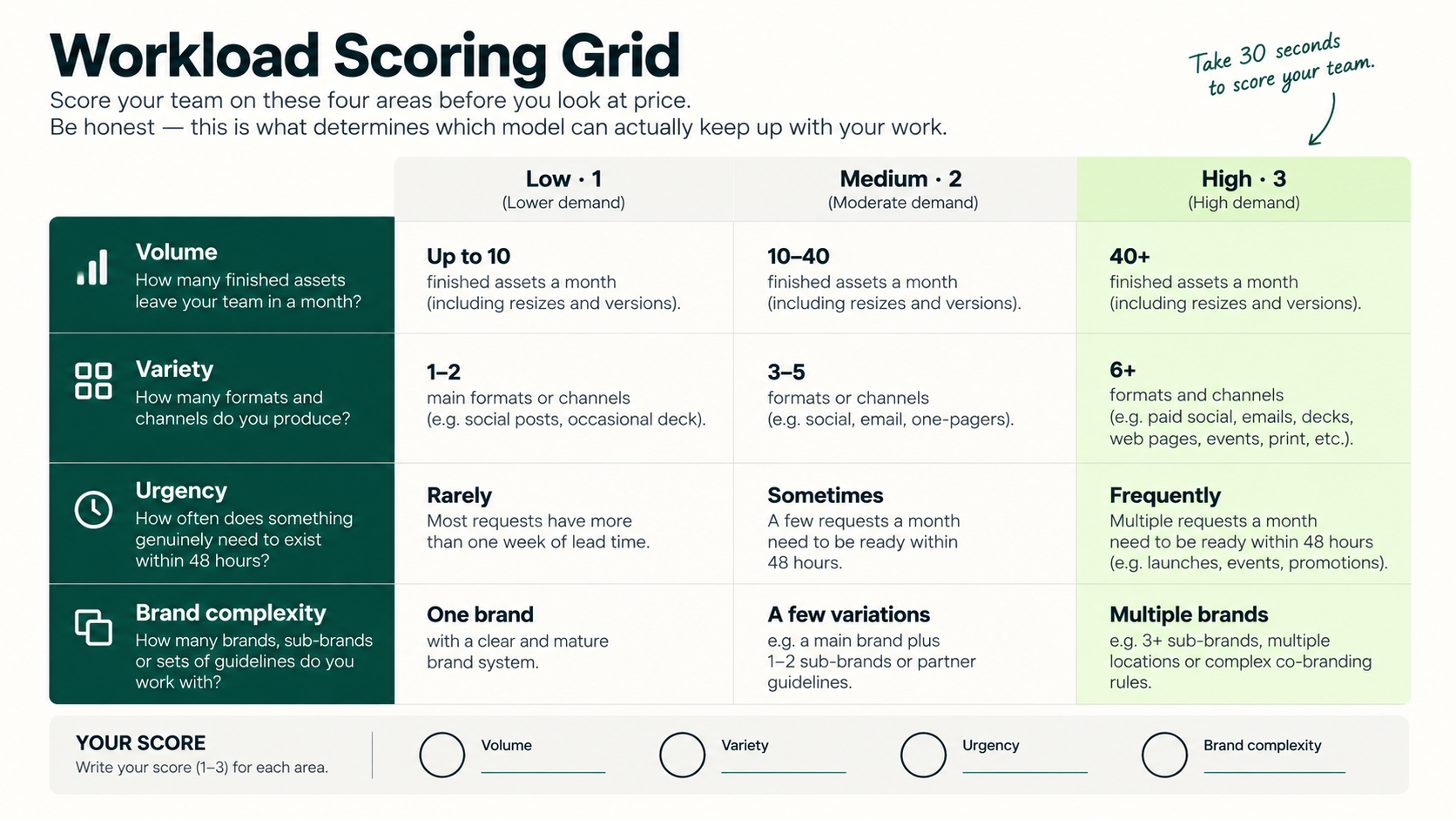
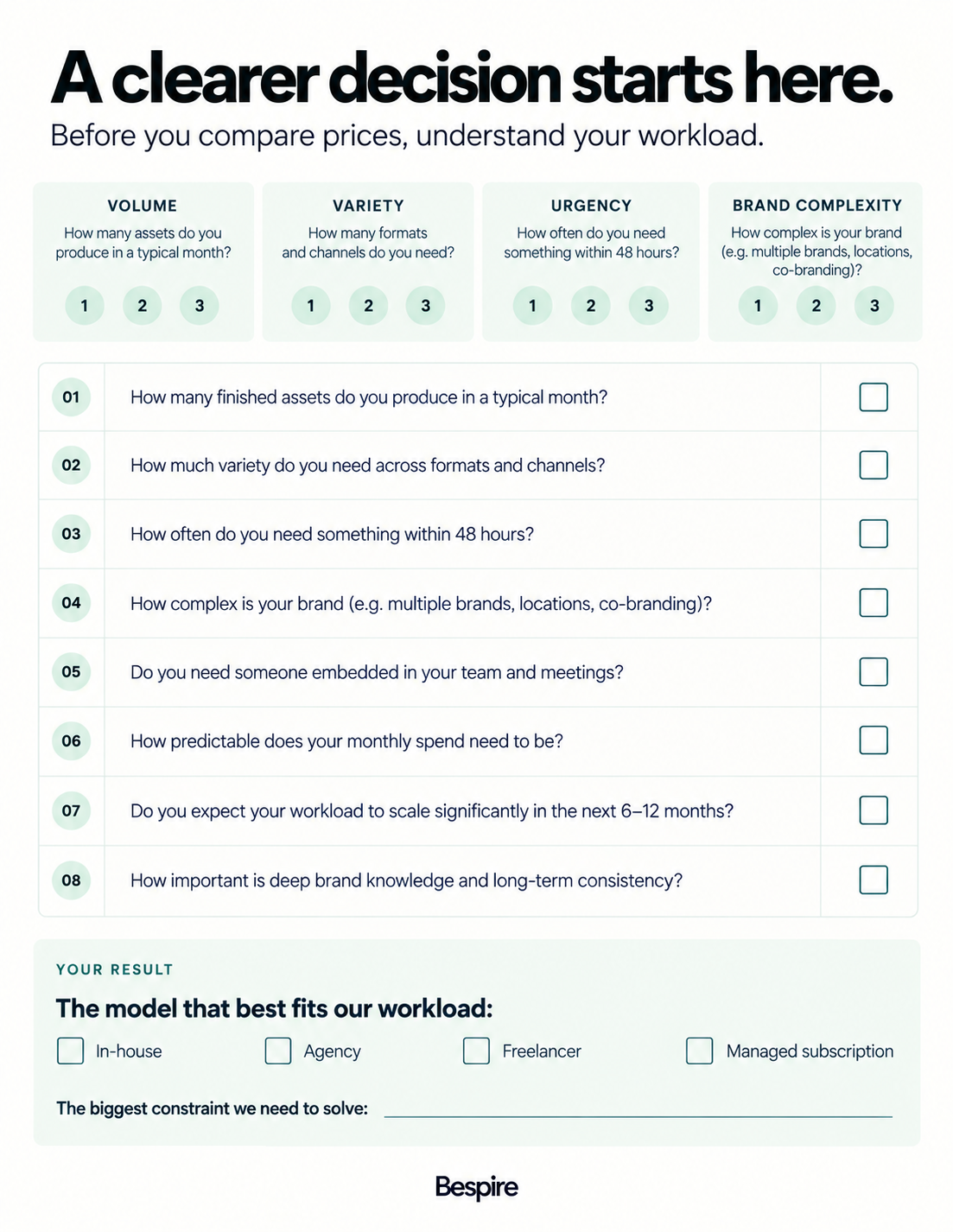
Score your team on these four before you look at price. Be honest; this is the part that determines whether the model survives contact with your calendar.
Volume. How many finished assets leave your team in a typical month, counting every resize and version? A team producing eight things a month and a team producing eighty look identical on a budget sheet and need completely different execution models.
Variety. How many formats and channels? Paid social in six sizes, a webinar kit, a sales one-pager, lifecycle emails, a trade-show banner and a product-launch page is a very different week from "social posts and the occasional deck." Variety is what breaks a single specialist.
Urgency. How often does something genuinely need to exist within 48 hours? Not "the CEO wants it now," but real deadlines driven by launches, events, promotions or paid-media cycles. A high-urgency team needs a model that is available, not just skilled.
Brand complexity. One brand with a mature system, or three sub-brands, twelve locations and a partner co-branding rulebook? Complexity is what makes every new pair of hands expensive, because each one has to learn the rules before they can produce anything on-brand.
Score each from 1 (low) to 3 (high). The pattern of your four scores, not the total, points at the model. The scoring sheet is at the end of this piece.
What each model is built to handle
Each option is good at something specific. The trouble starts when it is asked to do the thing it wasn't built for.
The in-house designer
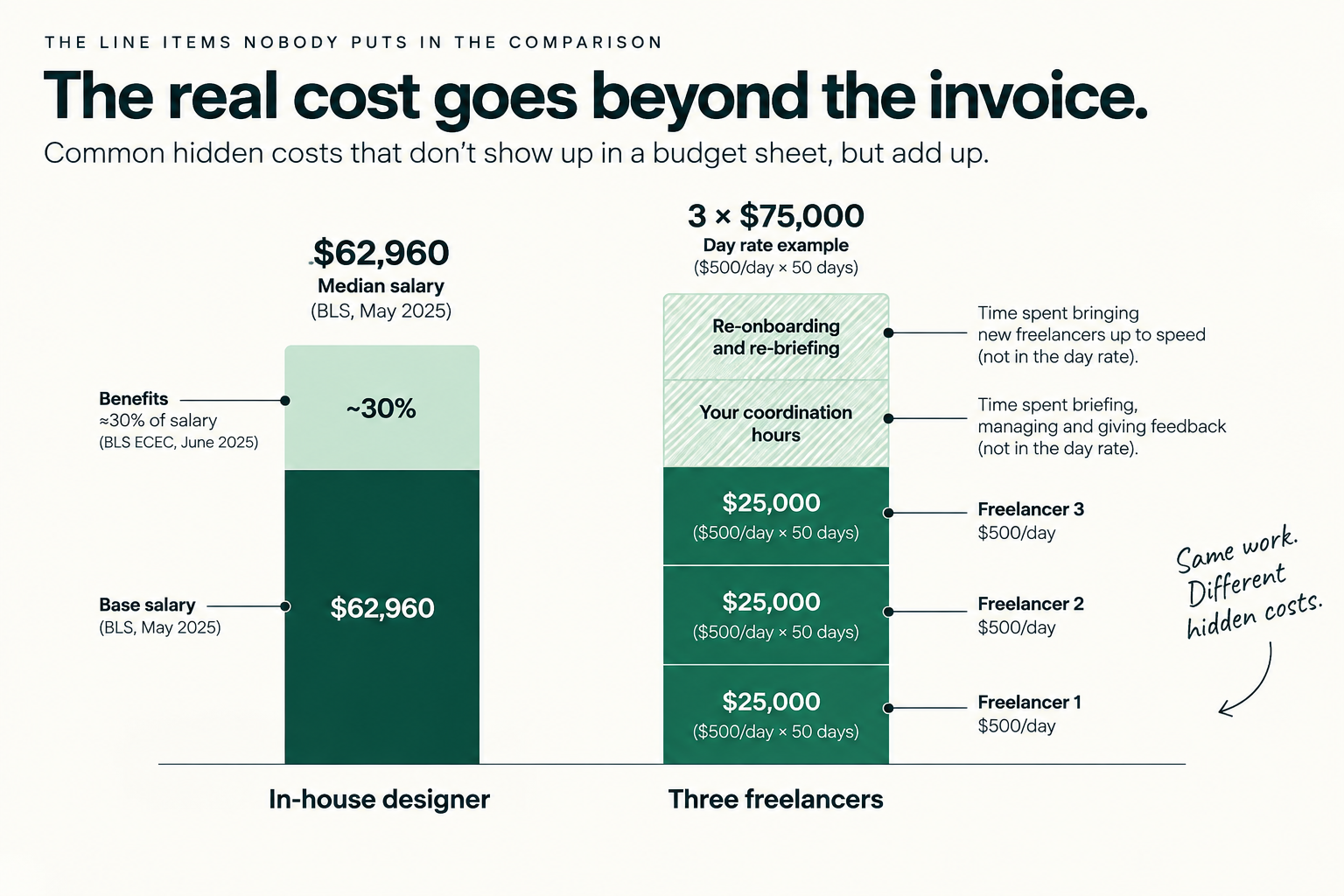
An in-house graphic designer is the best answer for brand judgement. They sit in your meetings, they know why the product page is blue, they catch the thing nobody briefed. The US Bureau of Labor Statistics puts the median graphic designer salary at $62,960 as of May 2025, and BLS employer-cost data shows benefits add roughly 30% on top of wages across private industry, so the real number is closer to $80–90K before recruiting and ramp. That is fine if the role is judgement. It is a poor way to buy volume: one person has one queue, one set of hours, and no cover when they are out. The tipping point is predictable enough that we wrote a separate piece on what happens when a team outgrows its one designer.
The project agency or retainer
An agency is built for concentrated, high-craft work with a defined start and end: a rebrand, a campaign concept, a launch. A marketing agency retainer buys you access to that depth on a recurring basis, but the operating model underneath is still project-shaped. Briefs go in, work comes back on the agency's timeline, and the weekly stream of small-to-medium assets that a marketing team actually lives on is either billed as scope creep or slotted around bigger accounts. The ANA's most recent study of in-house agencies, from 2023, found that even companies that had moved most creative work internal still kept external agencies, overwhelmingly for extra bandwidth and specialist skills. That is the honest job description of an agency: peaks and specialities, not the Tuesday stream.
Freelancers
Freelancers are the most flexible model on paper and the most fragile in practice. Upwork's 2025 Future Workforce Index reports 28% of skilled US knowledge workers now working independently, so the talent is there. The problem is what happens at three or more of them. Every freelancer is a separate onboarding, a separate interpretation of your brand, a separate calendar you don't control. The "agency vs freelancer" comparison usually misses that the manager becomes the agency: briefing, routing, chasing, consolidating feedback, and re-explaining the brand each time someone new picks up a file. Freelancers fit low-volume, low-complexity work, or specialist one-offs. They do not fit a queue.
The managed subscription or execution layer
This is the category Bespire sits in, so read this paragraph with that in mind. A design subscription in its basic form sells throughput: a flat monthly fee, a queue, a turnaround promise. The versions worth considering add the two things that make throughput usable, a project manager who owns intake and prioritization, and a creative director who holds the brand across every designer. That combination fits high-volume, high-variety, always-on work with a stable brand system. It does not fit two things: very low volume (you would be paying for capacity you never use, and a good freelancer will serve you better), and deep strategic brand work (a new identity, a campaign platform), which is agency territory and should stay there. Any subscription that tells you otherwise is optimizing for its own retention, not your work.
|
|
In-house designer |
Agency / retainer |
Freelancers |
Managed execution layer |
|
Best at |
Brand judgement, context, catching the unbriefed |
Concentrated high-craft projects: rebrands, campaigns, launches |
Low-volume or specialist one-offs |
High-volume, high-variety, always-on production on a stable brand |
|
Breaks on |
Volume, variety, cover when absent |
The weekly stream; lead time on urgent work |
Three or more hands; urgency; brand drift |
Very low volume; deep strategic brand work |
|
Who owns intake |
Usually the designer (a problem) |
Account manager, on the agency's cadence |
You |
A project manager on your queue |
|
Brand consistency |
One person's head |
Agency creative lead, per project |
Each freelancer's interpretation |
Creative director across all designers |
|
Availability |
One calendar, no cover |
Scheduled, weeks of lead time |
Whenever they are free |
Continuous, within plan capacity |
|
Cost nobody lists |
Recruiting, ramp, ~30% benefits on salary |
Scope creep on small work |
Your coordination hours; re-onboarding |
Unused capacity if volume is low |
Six workload profiles and the model that fits each
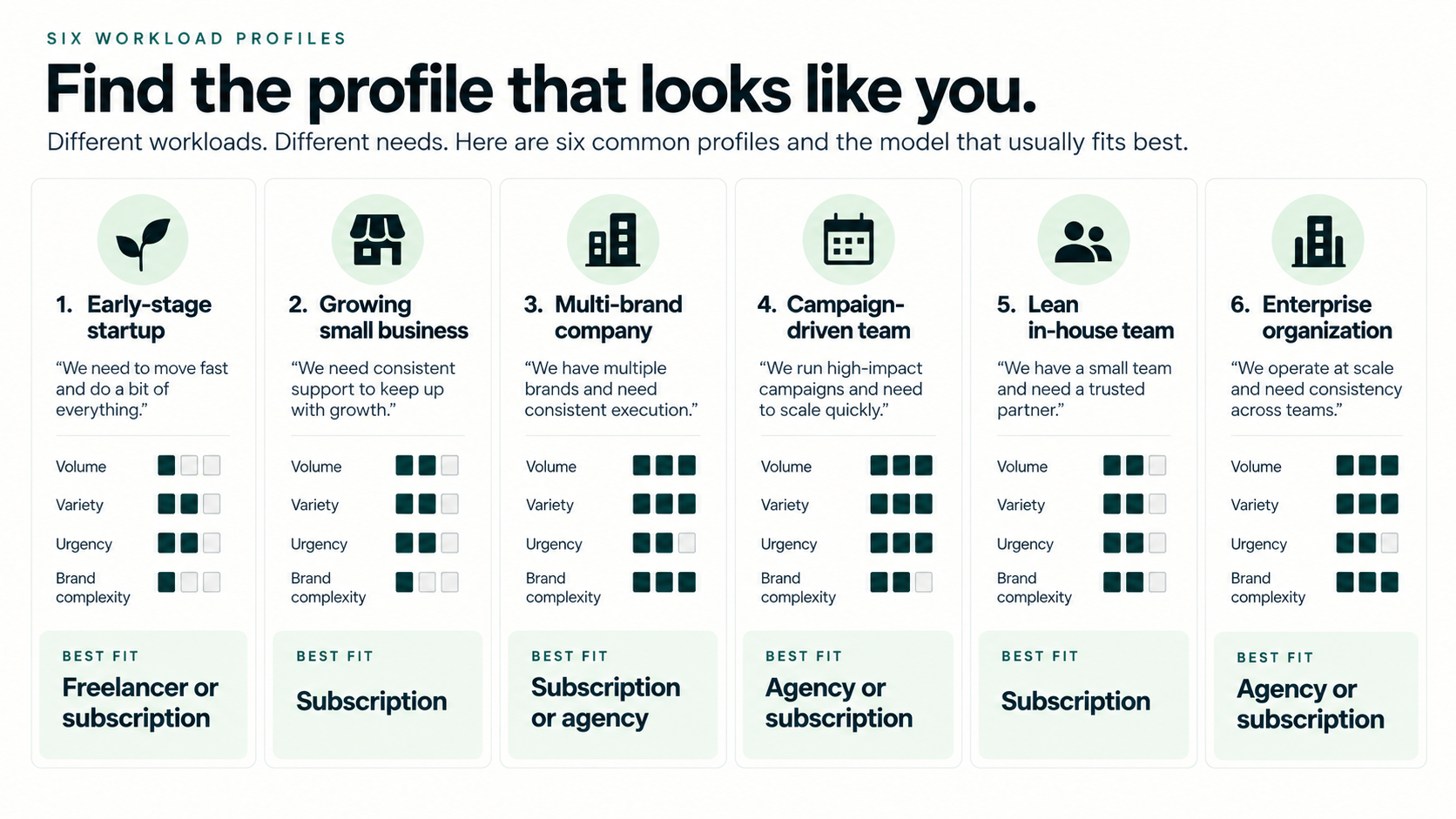
Run your four scores against these. Most teams recognize themselves in one of them within a minute.
Low volume, low variety, low urgency, one brand. A trusted freelancer or a small retainer. You do not need a system; you need a reliable person and a good brief template. Do not buy a subscription for this.
Low volume, high craft, one brand in transition. You are rebranding or launching a campaign platform. That is agency work, on a project basis. An execution partner can roll the new system out afterwards, but should not be the one designing it.
High volume, moderate variety, low urgency, one brand. An in-house designer can carry this for a while if the volume is predictable and the brand system is mature. Watch the queue age; when requests wait more than a week, you have crossed into the next profile. [Bespire insight opportunity: add a real example about what 'requests waiting more than a week' looked like in a client's queue before they changed model.]
High volume, high variety, high urgency, one brand. This is the lean SaaS marketing team: paid variants, launch kits, sales enablement, events, all at once, half of it needed this week. It breaks freelancers on availability and agencies on lead time. It is the profile a managed execution layer with a PM was built for, ideally under an in-house marketer or designer who keeps brand judgement.
Moderate volume, high brand complexity, multiple hands. Multi-location, multi-brand or franchise marketing. Volume alone isn't the problem; interpretation is. Five freelancers here means five versions of your brand. This profile needs one accountable brand interpreter and a system of templates, which is either a strong in-house creative lead plus managed production, or a small in-house team. Freelancer patchworks are the worst fit of all.
High volume everywhere, with an in-house team already. You do not need to replace anyone. You need overflow that doesn't require re-onboarding every quarter, so your in-house people can stop doing resizes and go back to the work only they can do. This is where the ANA's finding that 92% of in-house shops still use external partners for bandwidth comes from.
Notice that two of the six profiles say "hire" or "agency" and one says "freelancer." A comparison that ends with the same answer for every reader is not a comparison.
The line items nobody puts in the comparison
The budget sheet has one row per model. Real cost has at least four more.
Coordination time. Under a freelancer model, the marketing manager's week absorbs the project management. If a manager spends five hours a week routing and chasing work, that is an eighth of a senior salary spent on something a PM should own. It never shows on the sheet because it is already paid for.
Brand re-explanation. Every new pair of hands relearns the brand. With one in-house designer it happens once. With rotating freelancers it happens continuously, and every relearning produces at least one off-brand asset that costs a revision round. Complexity multiplies this.
Ramp-up per vendor. Hiring takes months. Agency onboarding takes weeks and a workshop. Each freelancer takes a day or two of your time before they are useful. Any model that churns hands pays ramp-up repeatedly.
Availability. A model that is excellent but unavailable on the day you need it has a cost that only appears as a missed date. Urgency scores are the proxy for this. If yours is high, weight availability above craft in the decision, because craft you cannot schedule is not capacity.
We saw this firsthand with a team working with three freelancers. Their marketing manager was spending too much time briefing, chasing work, and sorting out duplicated requests and version confusion. Moving to a managed queue took that coordination off their plate, freeing them to focus on marketing instead of managing production.
A one-page decision checklist
Before you compare prices, write down the answers to these.
1. How many finished assets left the team last month, counting versions? Is that number rising?
2. How many distinct formats or channels did they cover?
3. How many of those were needed within 48 hours of the request?
4. How many brands, sub-brands or locations do the assets have to honor?
5. Who currently owns intake and prioritization? If the answer is "the designer" or "whoever shouts," that is a workflow problem no model fixes on its own.
6. Which work must stay in-house because it is judgement rather than production?
7. What does "urgent" mean here, and who is allowed to say it?
8. If the current model disappeared next month, what would break first: quality, speed or brand consistency? That is the variable to solve for.
Conclusion
Answer those eight questions and the model usually chooses itself. If your scores say hire, hire. If they say agency, hire one for the project and don't ask it to be your Tuesday stream. If they say freelancer, find one good one and give them a proper brief. The wrong choice is almost never the model itself; it is a model picked for its price and then asked to absorb a workload it was never shaped for. Put the shape first, and the budget conversation gets shorter, because you are no longer comparing four prices for four different things.
Frequently Asked Questions
Is it better to hire a freelancer or use an agency?
It depends on the shape of the work, not the price. A freelancer fits low-volume, low-complexity work or a specialist one-off; an agency fits concentrated, high-craft projects with a clear start and end. Neither is built for a weekly stream of many small assets, which is where most marketing teams actually struggle.
Is agency or in-house better for marketing?
Neither as a general rule. In-house wins on brand judgement and day-to-day availability for one brand at steady volume; agencies win on big creative projects and specialist skills. Most companies with in-house teams still use external partners for overflow, so in practice the answer is usually a combination.
What are the drawbacks of in-house marketing?
A single in-house designer is one queue with no cover, a ceiling on how much and how many kinds of work they can produce, and a fully loaded cost around 30% above salary once benefits are included. The role is excellent for judgement and weak for throughput, which is why teams tend to add capacity around it rather than replace it.
How many designers does a small marketing team actually need?
Usually fewer than it thinks, if the work is organized. One in-house designer who owns brand judgement can cover a surprising amount when intake, prioritization and briefs are handled well. The moment requests routinely wait more than a week, the problem is capacity, and the fix can be a second hire, an agency for peaks, or a managed execution layer, depending on volume, variety, urgency and brand complexity.
Are design subscriptions worth it for a marketing team?
For high-volume, high-variety, always-on work on a stable brand, a design subscription with a real project manager and creative director can replace a patchwork of freelancers. For low volume or deep strategic brand work, it is the wrong tool: you pay for capacity you don't use, or you get production where you needed a concept.
Why does my design process take so long even though I have a good designer?
Because the elapsed time is rarely the design time. Most delays live in the workflow around the designer: unclear briefs, feedback from five people in three rounds, no one owning the queue, and urgent requests cutting in line. Fixing intake and approvals usually speeds things up more than adding a designer.
If your problem is a queue nobody owns
Bespire runs that queue for marketing teams every day: a project manager on intake and prioritization, a creative director holding the brand, and designers producing inside one system. It is the right fit for the high-volume, high-variety profiles above and the wrong fit for the low-volume ones, and we will say so.
Download the workload scoring sheet and checklist, and if you are not sure which profile you are, a 20-minute workflow review will tell you, including when the honest answer is that you don't need us.